CAT Q1 Earnings: $17.4B Revenue Smashes Estimates as Construction Surges 38%
wealthvista.top Editorial · May 23, 2026 · 11 min read
Executive Summary
Caterpillar delivered a commanding Q1 2026, with revenue of $17.4 billion rising 22% year-over-year and adjusted EPS of $5.54 handily beating the Wall Street consensus by roughly 20%. The headline numbers were good — the real story is in the backlog. A record $63 billion in unfilled orders, up 79% from a year ago, gives management a clear line of sight on revenue for the quarters ahead. The Construction Industries segment was the standout, growing 38% on the back of North American non-residential building activity. But the stock isn’t cheap: at 43x trailing earnings, even a best-in-class industrial name deserves some pushback on valuation before chasing it higher.
1. Quarter Highlights vs. Expectations
Revenue: $17.415 billion, up 22% YoY from $14.249 billion. Consensus had been around $16.4–16.6 billion, meaning Caterpillar beat by roughly $800 million to $1 billion — a solid outperformance.
Adjusted EPS: $5.54, compared to a Zacks consensus estimate of $4.55 and a more typical analyst forecast of $4.57–$4.65. The beat was about 19–22%, depending on which consensus number you use. GAAP EPS was $5.47.
Adjusted operating profit margin: 18.0%, down 30 basis points from 18.3% in Q1 2025. The compression reflects higher manufacturing costs — primarily tariff-related — that management partially offset through volume leverage and pricing power.
Revenue Breakdown
Total Q1 2026 revenue of $17.415 billion breaks down across segments as follows:
| Segment | Q1 2026 | Q1 2025 | YoY Change |
|---|---|---|---|
| Construction Industries | $7,161M | $5,184M | +38% |
| Power & Energy | $7,031M | $5,783M | +22% |
| Resource Industries | $3,797M | $3,661M | +4% |
| Financial Products | $1,096M | $1,007M | +9% |
| All Other / Eliminations | $(1,670M) | $(1,396M) | — |
| Consolidated Total | $17,415M | $14,249M | +22% |
The Construction Industries explosion (+38%) was the dominant story. North America alone grew 48%, driven by non-residential construction activity and a pickup in rental fleet loading. Power & Energy (+22%) was powered by data center prime power demand — large gas generator sets for AI infrastructure applications. Resource Industries was the weak link at just +4%, with segment profit down 39% due to tariffs and lower-than-expected volume.
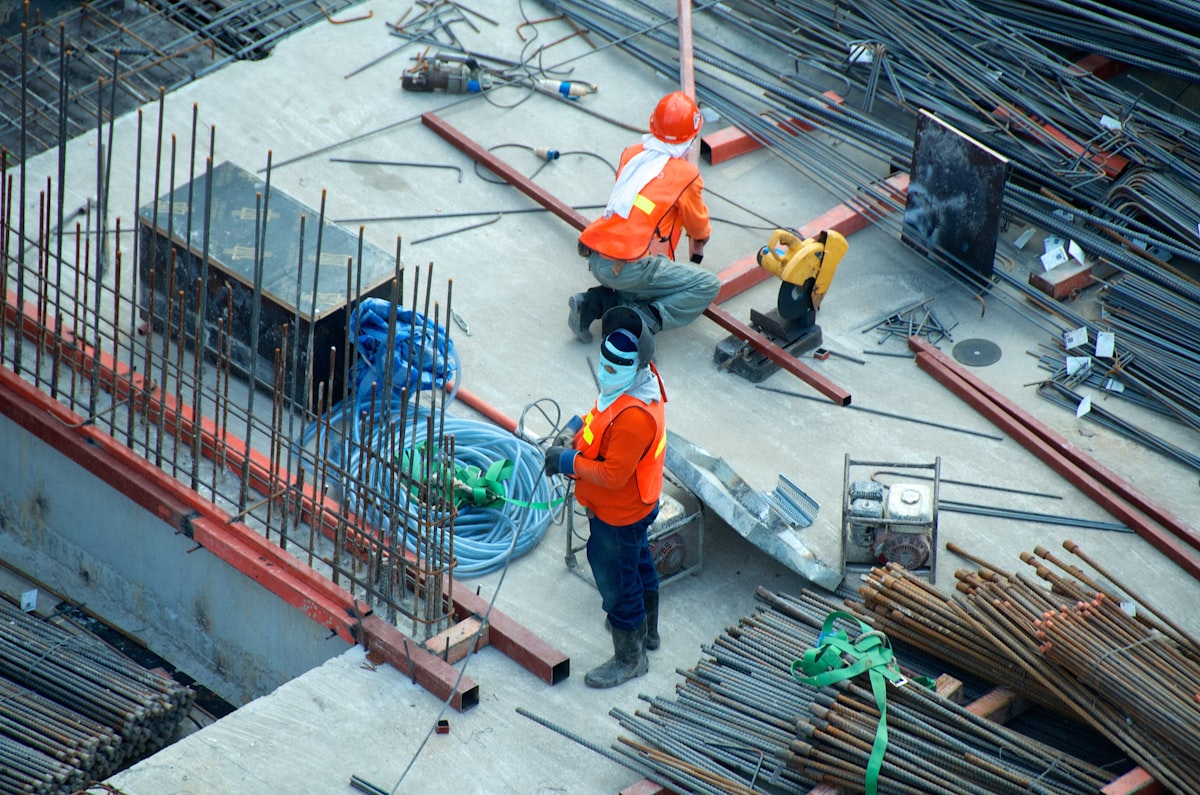 Heavy machinery and industrial equipment — Caterpillar’s core business delivered exceptional Q1 results.
Margin Performance
| Metric | Q1 2026 | Q1 2025 | Change |
|---|---|---|---|
| GAAP Operating Profit Margin | 17.7% | 18.1% | -40 bps |
| Adjusted Operating Profit Margin | 18.0% | 18.3% | -30 bps |
| Power & Energy Segment Margin | 20.6% | 22.3% | -170 bps |
| Construction Industries Segment Margin | 21.4% | 19.8% | +160 bps |
| Resource Industries Segment Margin | 10.0% | 17.0% | -700 bps |
Despite tariff-related manufacturing cost headwinds, Construction Industries managed to expand margins by 160 basis points through volume leverage and favorable pricing. The combined effect of tariff costs was roughly $600 million in the quarter — favorable to management’s January estimate — but still a meaningful drag on consolidated margins.
Sources: Q1 2026 Press Release — PR Newswire · Q1 2026 Earnings Transcript — The Motley Fool
2. Business Segment Analysis
Construction Industries — The Star of the Quarter
This segment generated $7.161 billion in sales, up 38% year-over-year, with segment profit of $1.535 billion up 50%. North American construction was the primary catalyst: sales to users grew 7% overall, but North America specifically jumped 48%. Non-residential construction activity — office buildings, warehouses, data center site prep — drove the volume. Dealers also built inventory in anticipation of continued strong demand, adding roughly $1.5 billion in seasonal inventory (versus a slight drawdown a year ago).
Management cited ongoing rental fleet loading as a tailwind and confirmed that CONEXPO announcements around the CAT compact initiative should expand addressable market in the small contractor segment. The margin expansion here — +160 bps to 21.4% — is the number to watch. If this segment sustains 20%+ margins while growing at high-teens to 20%+ rates, it re-rates the entire company’s blended margin profile.
Power & Energy — AI Infrastructure Tailwind
Power & Energy hit $7.031 billion in sales (+22%) with $1.450 billion in segment profit (+13%). The headline number here is power generation: sales grew 41% in this application, driven by large reciprocating engines and turbines sold into data center prime power applications. Management noted that six agreements of at least 1 gigawatt each for prime power applications are now in the backlog, with another 2.1 gigawatt agreement announced in the quarter. This is the clearest direct line from AI infrastructure buildout to an industrial company’s order book.
Oil and gas ( reciprocating engines in gas compression) grew 16%, and industrial applications added another 5%. The segment margin of 20.6% was down 170 bps due to tariffs, but absolute profit still grew meaningfully. The long-term capacity expansion plan — targeting nearly 3x 2024 large reciprocating engine output by 2029 — reflects management’s conviction in sustained data center demand.
Resource Industries — Tariff Victim
The weakest segment by far. Sales rose just 4% to $3.797 billion, but segment profit collapsed 39% to $378 million and margin dropped 700 basis points to 10.0%. Management attributed roughly 500 basis points of that margin decline directly to tariff costs, with the rest from lower-than-expected volume. Mining sales were higher year-over-year — copper, gold, fleet replacement — but heavy construction and quarry/aggregates were roughly flat and rail remained depressed. The February acquisition of mining software company RPMGlobal adds a technology layer but won’t move the needle near-term.
Financial Products
Revenue of $1.096 billion (+9%) and segment profit of $245 million (+14%). Retail new business volume hit a 15-year first-quarter high. Credit quality remains solid: past dues at 1.39% (down 19 bps) and allowance rate at 0.86%, matching a historical low. This segment is a quiet contributor — not a growth engine, but steady.
3. Management Guidance vs. Street Expectations
Caterpillar’s full-year 2026 guidance calls for low double-digit sales and revenue growth, an improvement in adjusted operating profit margin relative to prior expectations, and tariff costs of $2.2–$2.4 billion (revised down from the prior $2.6 billion estimate — a positive surprise). The reduction reflects an adjustment to the computation methodology for 2025 tariffs, not a change in tariff policy.
The company raised its long-term growth targets at its Investor Day, with enterprise sales and revenues now expected to grow at a 6%–9% compound annual growth rate through 2030 (up from prior targets). The power generation business is now guided to more than 3x its 2024 baseline by 2030 — a direct reflection of data center and energy transition demand.
For Q2 2026 specifically, management expects tariff costs of approximately $700 million, with half impacting Construction Industries, and the remainder split between Power & Energy and Resource Industries.
Analyst consensus for full-year 2026 EPS sits around $24.67, implying roughly 23% growth from 2025’s roughly $20 TTM EPS. The stock has already done significant work, so the bar for upside from here is meaningfully higher.
4. Balance Sheet and Cash Flow Health
| Balance Sheet Item | Q1 2026 | Note |
|---|---|---|
| Enterprise Cash | $4.1 billion | Down from $10.0B at year-end 2025 |
| Operating Cash Flow | $1.9 billion | Up ~$580M YoY |
| MP&E Free Cash Flow | ~$600 million | Up ~$350M YoY |
| Share Repurchases (Q1) | $5.0 billion | Including $4.5B accelerated share repurchase |
| Dividends (Q1) | $0.7 billion | |
| Total Returned to Shareholders | $5.7 billion | Extreme confidence move |
The balance sheet tells a story of a company willing to empty the vault. Enterprise cash went from $10 billion at year-end 2025 to $4.1 billion after deploying $5.7 billion in buybacks and dividends in a single quarter. This is a bold capital allocation signal — management is essentially saying it sees the stock as attractively valued even at a 43x trailing P/E.
The $4.5 billion accelerated share repurchase (ASR) is particularly notable. ASRs are typically used when management wants to retire a large block of shares quickly without waiting for open-market purchases. Combined with the ongoing base repurchase program, the company is aggressively reducing its share count, which is mechanically EPS-accretive.
Free cash flow of roughly $600 million for the quarter (MP&E segment) was up $350 million year-over-year, driven primarily by profit growth. The gap between FCF and the buyback size reflects the company’s view that it can fund buybacks even while investing in capacity expansion.
5. Valuation Assessment
At a recent price of approximately $872.68:
| Metric | Value | Context |
|---|---|---|
| Trailing P/E (TTM) | ~43x | Elevated — above historical average for CAT |
| Forward P/E (2026E) | ~35x | Based on ~$24.67 consensus EPS |
| EV/EBITDA | ~26.6x | Above sector median |
| EPS Growth (2026E YoY) | ~23% | Strong |
| PEG Ratio | ~1.9x | Pricey relative to growth |
Caterpillar is not a cheap stock. Trading at 43x trailing earnings and 35x forward earnings for a company expected to grow EPS ~23% gives a PEG ratio approaching 2x. For context, the stock historically trades in the 15–25x P/E range during normal industrial cycles, with expansions up to 30x during peak years. The current multiple reflects both the AI infrastructure narrative driving Power & Energy demand and the scarcity premium for industrial names with clear long-term growth targets.
EV/EBITDA of 26.6x also sits above peers. Industrial conglomerates with exposure to energy transition and data center power typically command a premium, but this leaves limited margin of safety if growth disappoints.
The bull case for valuation: if Power & Energy sustains 20%+ growth driven by data center orders and the 6–9% long-term CAGR target materializes, the forward P/E becomes more reasonable at 25–28x a few years out. At that point, today’s price looks like fair value.
The bear case: a 43x multiple for an industrial company with meaningful exposure to construction cycles, resource commodities, and geopolitical tariff risk is pricing in near-perfection. Any margin miss, demand slowdown in non-residential construction, or tariff escalation could be painful.
6. Competitive Positioning and Catalysts
Caterpillar occupies a rare position among industrial companies: it is both the dominant player in off-highway heavy equipment and a meaningful beneficiary of the AI data center buildout through its large reciprocating engine and power generation business. The competitive moat in core construction and mining equipment — built over decades of dealer networks, brand loyalty, and parts/service relationships — is structural and unlikely to erode.
Key catalysts from this quarter’s call:
Data center power agreements: The sixth agreement of at least 1 gigawatt, plus the newly announced 2.1 gigawatt deal, put Caterpillar front and center in AI infrastructure. If the 15 gigawatts of annual capacity expansion referenced on the call materializes, this becomes a durable revenue stream rather than a one-time surge.
RPMGlobal acquisition: Completed in February 2026, bringing mining software technology that complements Caterpillar’s existing autonomy and equipment offerings. Long-term, this could accelerate productivity software adoption across the mining customer base.
CONEXPO CAT compact launch: A streamlined customer experience for small contractors could unlock a new customer segment and support the 1.25x sales-to-users growth target for Construction Industries through 2030.
Capacity expansion: The near-tripling of large reciprocating engine capacity by 2029 is a multi-year revenue and margin tailwind, assuming data center demand remains elevated.
On the competitive front, Deere remains the primary rival in construction equipment, while Wartsila and Rolls-Royce are key competitors in large power generation. CAT’s advantage is breadth: a single OEM that can supply equipment, engines, and financial services across construction, mining, energy, and industrial applications creates cross-selling opportunities rivals can’t match.
7. Key Risks
Tariff cost escalation. Management guided $2.2–$2.4 billion in full-year tariff costs, down from $2.6 billion, but the situation remains fluid. Additional tariffs under IEEPA or escalation of existing Section 232/122 duties could reopen the cost pressure. Resource Industries is most exposed, but Construction Industries is not immune — management flagged that roughly half of Q2 tariff costs will fall on Construction. The risk is not just the cost itself but the uncertainty, which makes forward margin modeling difficult.
Construction cycle peak risk. North American non-residential construction has been running hot, but every construction cycle eventually turns. With dealer inventory building $1.5 billion in the quarter (versus a drawdown a year ago), there’s a risk that end-demand slows just as the supply pipeline fills. If Construction Industries margin reverts as volume growth normalizes, the consolidated margin story gets harder.
Resource Industries margin recovery uncertainty. The 700 basis point margin collapse in Resource Industries in one quarter is a red flag. If copper and gold mining capex slows, or if tariff costs remain elevated, this segment could stay under pressure. The backlog growth provides some insulation, but Resource Industries tends to be lumpier and more commodity-price-sensitive than the other segments.
8. Investment Conclusion
BUY with valuation caveat. Caterpillar reported genuinely strong Q1 results — the revenue beat, the EPS outperformance, the record backlog, and the long-term target raise all support the bull case. The Power & Energy data center narrative is real and appears in the numbers. Management’s willingness to deploy $5.7 billion in shareholder returns in a single quarter signals confidence.
The problem is price. At 43x trailing earnings, the stock has already discounted a lot of good news. A patient investor might wait for a pullback or for the next couple quarters of backlog conversion to confirm that the 22% revenue growth is durable rather than front-loaded. The underlying business is excellent. The timing from a valuation standpoint is less compelling.
Price target: $950–$1,050 over 12 months, based on 38–40x forward 2027 EPS of approximately $30.53. The bull case requires Power & Energy to sustain mid-teens growth and Construction to avoid a hard correction. The bear case — tariff escalation, construction downturn, resource commodity weakness — could bring the stock back to the $700s.
Bottom line: Great company. Questionable entry point. The backlog is your friend if you’re already long; it gives you time to watch before building a new position.